NuGleason: Gleason grading AI software for prostate cancer
Heatmaps, Gleason scores and standardised reports from the whole slide image.
Primary target: Gleason grading AI software
Gleason grading, with the pathologist in the loop
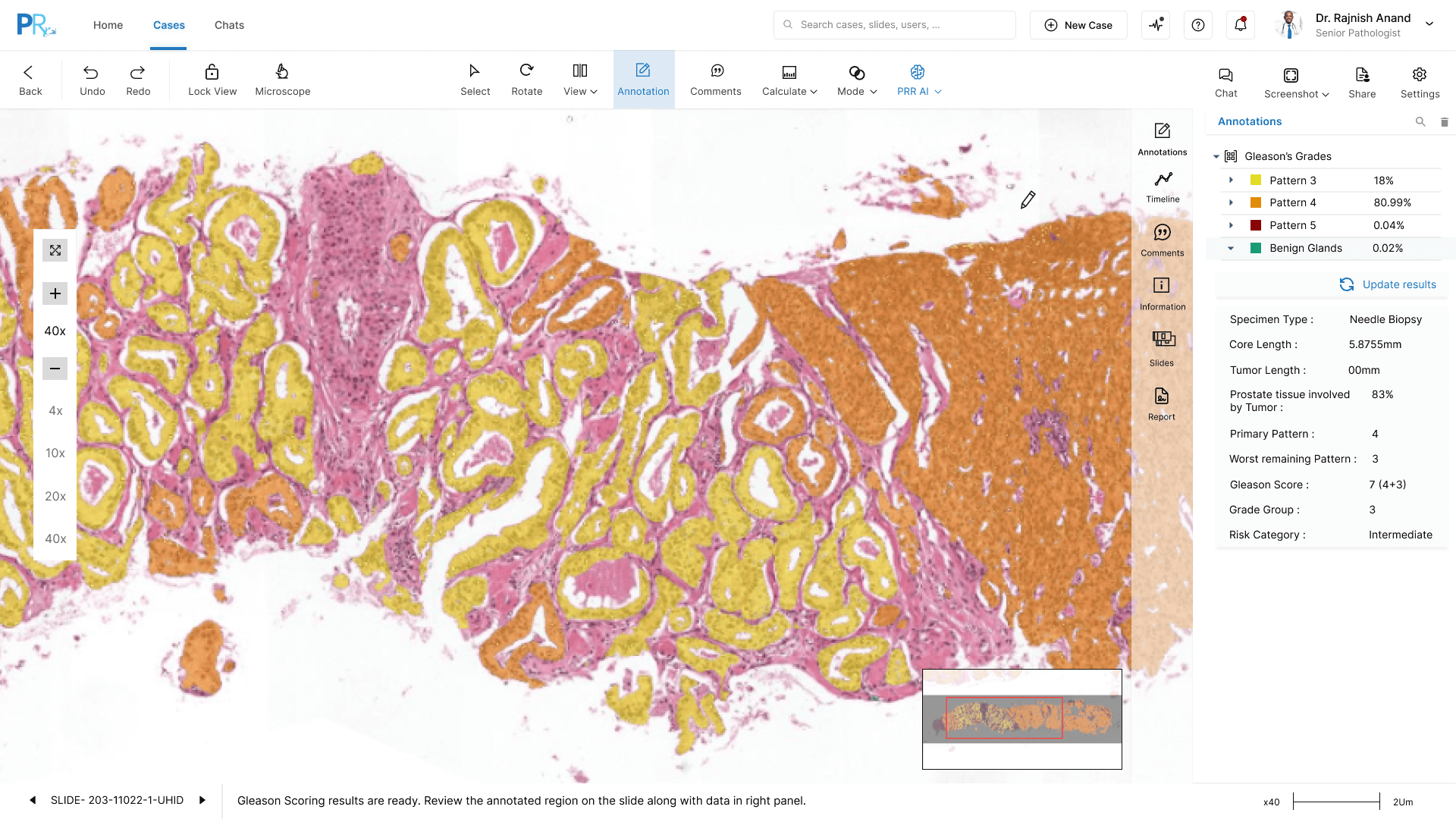
NuGleason is a Gleason grading tool for prostate cancer from PRR.AI. It applies AI to whole slide images for prostate cancer detection and grading, and returns three outputs to the reporting pathologist: a heatmap showing where the model found tumour, a Gleason score, and a standardised report.
NuGleason runs on Computer Vision AI, PRR.AI's digital pathology platform, and is viewed inside PathVu. It is decision support: the pathologist corrects the model in real time and signs the report.
01
Detection
The model reads the whole slide image and localises regions of interest, rather than returning a single slide-level label.
02
Grading
Regions are graded and combined into a Gleason score, presented alongside the heatmap that produced it so the pathologist can see the evidence.
03
Reporting
Output is assembled into a standardised report, consistent between cases and between reporting pathologists.
Every grade shown on the tissue that produced it
The score is not a number handed down on its own. Each Gleason pattern is drawn on the slide, so a pathologist can agree or disagree with the region, not just the result.
Consistency is the clinical problem
Gleason grading carries known inter-observer variability. A tool that reports the same way every time addresses the variability, not the pathologist.
What NuGleason changes
- The same grading logic applied to every case
- A visible heatmap, so the score can be interrogated rather than trusted
- A standardised report format across the reporting team
- Real-time correction recorded when the pathologist disagrees
What it does not change
- The pathologist reads and signs every case
- The model does not issue a diagnosis
- Nothing is auto-filed to the patient record
Regulatory status: NuGleason is decision support used with a pathologist in the loop, not a stand-alone diagnostic device. Ask us for the current regulatory position in your market before deployment.
NCG CATCH grant recognition, and a published method
NuGleason is recognised under the NCG CATCH grant programme. Separately, the PRR.AI pathology team's method for nuclear segmentation and classification in colon histology was developed for the CoNIC grand challenge and published on prr.ai.
- NCG CATCH grant programme recognition
- CoNIC challenge method: six nucleus classes, Lizard dataset, around half a million labelled nuclei
- Hematoxylin-aware dual-encoder architecture over a Preact-ResNet backbone
NuGleason: frequently asked questions
What is NuGleason?
NuGleason is a Gleason grading tool for prostate cancer from PRR.AI. It applies AI to whole slide images for prostate cancer detection and grading, and returns heatmaps, Gleason scores and standardised reports to the pathologist.
Does NuGleason replace the pathologist?
No. NuGleason is decision support with a human in the loop. The pathologist reviews the heatmap and the proposed score, corrects the model in real time where they disagree, and signs the report.
What does NuGleason output?
Three things: a heatmap localising the regions the model identified, a Gleason score, and a standardised report. The heatmap matters because it lets the pathologist check the score against the tissue rather than accept a number.
Is NuGleason approved as a medical device?
NuGleason is positioned as decision support used with a pathologist in the loop, not as a stand-alone diagnostic device. Regulatory status differs by market, so ask us for the current position for yours before deployment.
How does NuGleason relate to PathVu and Computer Vision AI?
Computer Vision AI is the platform. NuGleason is the Gleason grading model that runs on it, and PathVu is the viewer the pathologist works in. They are bought together in a pathology deployment.
Send us ten prostate slides
A small de-identified set from your own scanner. We will return the heatmaps, the scores and the reports, and your pathologist tells us where the model is wrong.
Request a demo